
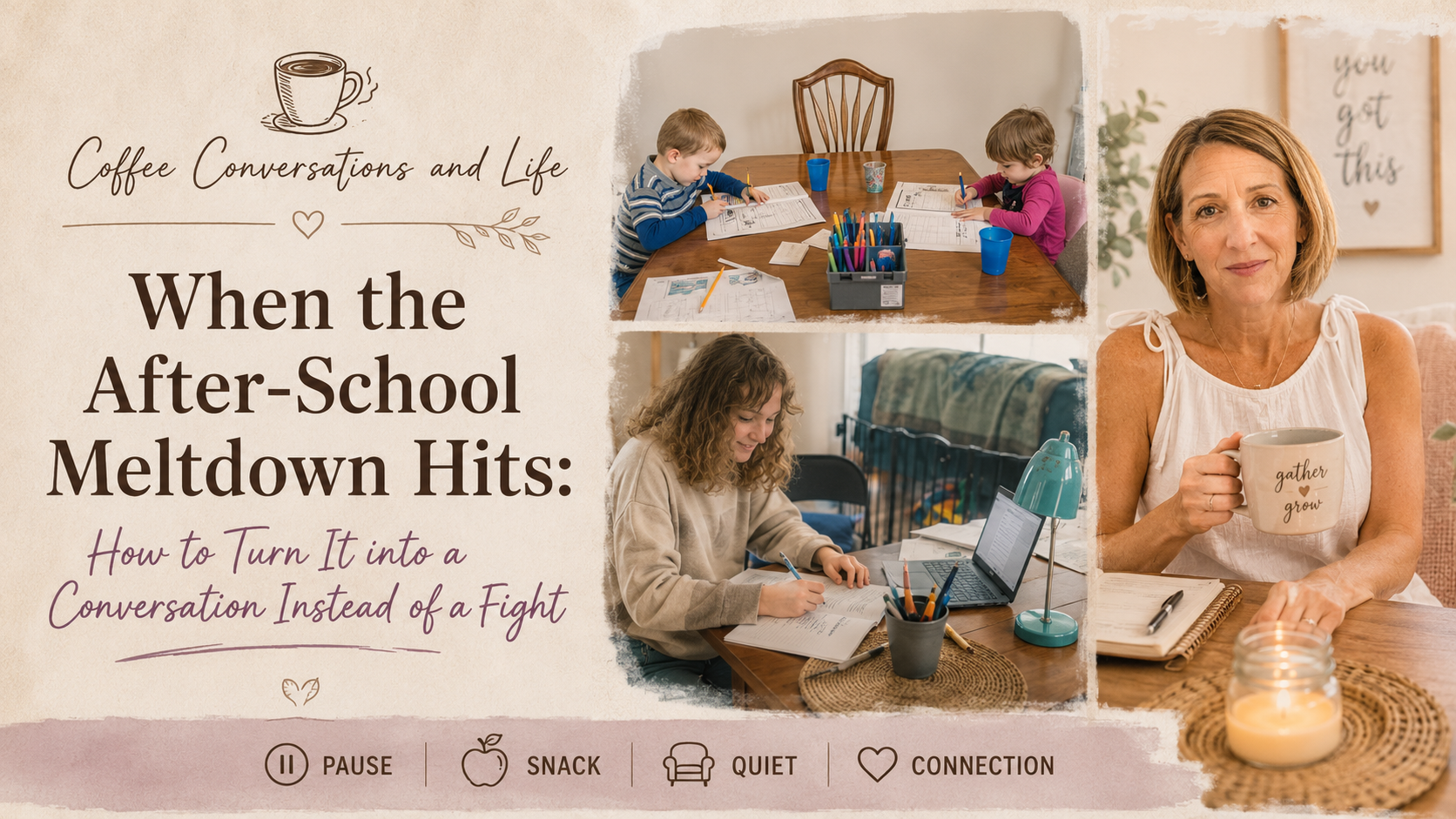
When the After-School Meltdown Hits: How to Turn It into a Conversation Instead of a Fight
The front door closes harder than it needs to.
A backpack lands in the middle of the hallway. One shoe comes off near the door, while the other somehow makes it halfway into the kitchen.
You have barely walked in from work—or maybe you have another child asking for help, a dog that needs to go outside, and dinner already occupying the back of your mind. The coffee you reheated earlier is still sitting cold on the counter.
Then your child asks for a snack.
You offer the wrong one.
Suddenly, they are snapping at you. A sibling says something harmless, and that starts another argument. You mention homework, and the volume rises again.
Now you are raising your voice too.
Inside, you are thinking, Not again. Why is this such a battle every day?
This is the moment when the afternoon can go in one of two directions. It can become a fight about disrespect, shoes, homework, and attitude—or it can become the beginning of a conversation.
Not an immediate conversation, necessarily.
Sometimes the first step toward a better conversation is knowing when not to talk.
Why After-School Can Be So Hard
Many children spend the entire school day working hard to hold themselves together.
They follow directions, move from one activity to another, manage friendships, complete assignments, sit through noise, and respond to expectations from multiple adults. Even when they have had a reasonably good day, all of that takes energy.
By the time they get home, their emotional battery may be nearly empty.
Home is also where many children feel safe enough to let go. They may have spent hours trying to be patient, cooperative, quiet, focused, or “good.” Once they walk through the door, all the feelings they have been carrying can come pouring out over something as small as the wrong snack.
School can also be physically and mentally overwhelming. There are bells, crowded hallways, bright rooms, conversations, transitions, assignments, and constant demands. Some children handle those things more easily than others, but nearly every child has days when it is simply too much.
An after-school meltdown does not automatically mean you are doing something wrong.
It does not mean your child is bad, spoiled, or deliberately trying to ruin the afternoon.
Often, it means they have reached the place where they finally feel safe enough to stop holding everything in.
That does not mean hurtful behavior should be ignored. It means we may need to help the child settle before we try to correct, teach, or solve the problem.
Try This: Pause + Snack + Quiet
When emotions are already high, I need something simple enough to remember without looking at a parenting book or searching for advice on my phone.
The framework I come back to is:
Pause. Snack. Quiet.
It is not complicated, and it will not produce a perfectly peaceful afternoon every time. It simply creates a gentler transition between school and home.
Step 1: Pause
When your child walks in snapping, yelling, or complaining, your first instinct may be to correct the behavior immediately.
“Do not speak to me like that.”
“Pick up your backpack.”
“You need to calm down.”
Those responses are understandable. You are tired too, and you deserve to be treated respectfully.
But correcting a child in the hottest part of the moment often adds more heat.
Before responding, pause for a few seconds.
Place one hand on the kitchen counter and notice that it is solid beneath you. Take one slow breath, making your exhale a little longer than your inhale.
You might quietly remind yourself:
This is a hard moment. I do not have to solve it in the next ten seconds.
The pause is not about pretending the behavior is acceptable. It is about keeping your own stress from joining your child’s stress and taking over the room.
You can address the backpack, the raised voice, or the unkind words later. Right now, the goal is to keep the moment from becoming a full family explosion.
Step 2: Snack
A simple transition routine can remove a surprising amount of conflict.
After school, offer:
- A familiar snack
- Water
- About ten minutes without additional demands
This does not need to be elaborate. It might be crackers and cheese, apple slices, yogurt, toast, or whatever reliably works in your home.
Children often arrive home hungry, thirsty, and tired without recognizing those feelings clearly. Instead of saying, “I am overwhelmed and my energy is low,” they may yell because the banana broke or accuse a sibling of looking at them.
A snack will not solve every emotional problem, but food and water can give the body enough support to begin settling.
Making this part of the daily routine can also reduce negotiation. Instead of asking a string of questions, you can simply say:
“Your snack and water are ready. Take a few minutes.”
The predictability matters. Your child begins to learn that they do not have to move directly from the demands of school into homework, chores, questions, or family activity.
There is a small landing place in between.
Step 3: Quiet
Once the snack is available, lower the stimulation for a few minutes.
This is not the time for a detailed conversation about school.
Try to avoid:
- “How was your day?”
- “What homework do you have?”
- “Why are you acting like this?”
- “What happened this time?”
- “Did you remember to turn in your assignment?”
Even friendly questions can feel like one more demand when a child is already overloaded.
Give them a quiet place to sit, draw, look at a book, listen to calm music, or simply stare into space for a few minutes. Some children may want to be close to you without talking. Others may need a little physical space.
This is not avoiding the issue.
It is choosing a better time to address it.
We usually do not have our best conversations while someone is slamming doors, crying, yelling, or trying to defend themselves. A short quiet period gives both of you a chance to return to the conversation with more patience.
One Sentence to Use in the Moment
When I do not know what to say, I try to use one simple sentence:
“It looks like today took a lot out of you.”
Another option is:
“Your body and brain seem really tired from school.”
Neither sentence excuses yelling or unkind behavior. It simply lets your child know that you see the struggle underneath the behavior.
Validation matters because children often become more defensive when they feel judged or misunderstood. When they feel seen, they may not need to fight quite as hard to prove that something is wrong.
You are not agreeing with every reaction.
You are saying, “I can tell this is hard.”
That small shift can change the tone of the entire afternoon.
Have the Deeper Conversation Later
The real conversation should happen after the snack, the quiet, and the emotional storm have passed.
That may be twenty minutes later. It may be during dinner, in the car, while folding laundry, or at bedtime.
You do not need to sit across from your child and announce that it is time for a serious discussion. Some children talk more freely when they are doing something beside you rather than looking directly at you.
Start gently.
You might ask:
- “What was the hardest part of today?”
- “Was there a moment you wish had gone differently?”
- “Did anything surprise you today?”
- “Was there a time when everything started to feel like too much?”
- “Is there anything we can do at home to make after-school feel easier?”
Then try to listen longer than feels natural.
As parents, we often move quickly into fixing mode. We offer advice, explain what the child should have done, contact the teacher in our minds, or begin planning tomorrow before the child has finished describing today.
Sometimes children need help solving the problem.
Sometimes they simply need somewhere safe to put the story.
You can always ask:
“Do you want help thinking through this, or do you mostly want me to listen?”
That question gives your child some control and helps you avoid offering a five-step solution when what they really needed was two quiet minutes of understanding.
Coffee-Conversation Scripts for Real Afternoons
You do not need a perfect speech. A few calm words are enough.
Here are some scripts you can adjust to fit your family:
“Sounds like today took a lot out of you. Want to have a snack first and tell me about it when you’re ready?”
“Let’s sit for a minute. You can eat, and when you feel ready, I’d love to hear what today was like.”
“We both had long days. Let’s take five quiet minutes before we figure out homework and dinner.”
“I can see that you’re upset. I’m going to give you a little space, and we’ll talk when things feel calmer.”
“You are allowed to have a hard day. You are not allowed to hurt people because of it. Let’s reset and try again.”
That last sentence can be especially useful when you need to validate the feeling while still holding a boundary.
The words do not have to sound polished. Your child is not grading your script.
A steady tone and a willingness to reconnect matter more than saying everything exactly right.
Routines Can Make the Transition Easier
After-school meltdowns do not exist in isolation.
A rushed morning can leave everyone starting the day already stressed. An unpredictable evening can make it harder for children to settle, sleep, and prepare for the next day. Small routines can reduce the number of decisions and transitions everyone has to manage.
That is why I also recommend creating a simple morning routine that works in your actual home—not an idealized routine involving color-coded bins and children who cheerfully wake up before the alarm.
You can read “From Morning Chaos to ‘We Made It on Time’: A Simple Routine That Actually Works” for a practical place to begin.
I will also be sharing more posts about children’s emotions, behavior, school stress, and the everyday conversations that help families feel more connected.
None of these routines will eliminate every difficult afternoon. They simply give you and your child something familiar to return to when the day feels unsteady.
Try It for One Week
After-school meltdowns happen in many homes, even if families do not always talk about them.
You are not the only parent standing in a kitchen with cold coffee, scattered shoes, and no idea why a granola bar has suddenly become the final straw.
Try Pause + Snack + Quiet for one week.
Pause before correcting.
Offer food and water.
Create a short, low-pressure quiet period.
Use one validating sentence.
Then have the deeper conversation later, when both of you are more able to listen.
Notice whether the intensity changes. Notice whether recovery happens a little faster. Notice whether your child begins to expect that small landing place after school.
Some days it may work beautifully. Other days, you may lose your patience before the backpack even hits the floor.
That does not mean the approach has failed.
This is a new skill for both of you, and new skills rarely look graceful at first.
Keep practicing. Keep repairing when things go wrong. Keep choosing connection whenever you can.
And join the email list for more practical routines, realistic scripts, and honest conversations about making family life feel a little calmer—one ordinary day at a time.